

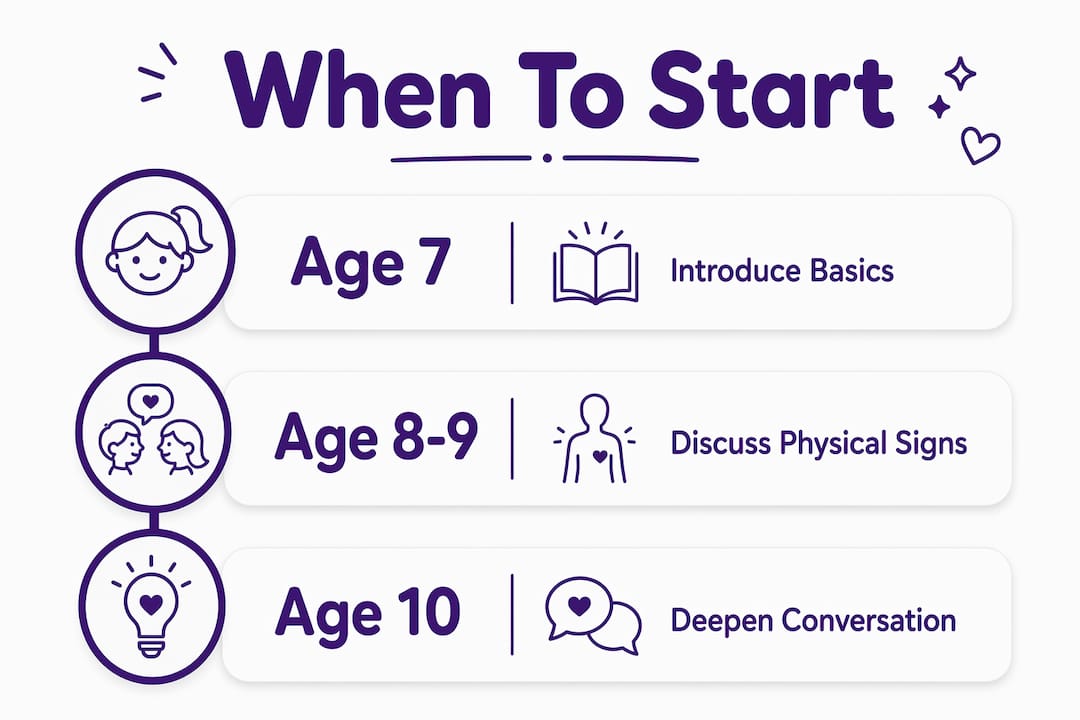
The ideal age to start period talks is between 7 and 10 years old, well before most girls experience their first period. The average age of first menstruation in the US is about 12, but the range spans from 10 to 15 years old. That gap is exactly why early conversations matter. A girl who already understands what a period is will feel prepared and confident when it arrives. One who hears about it for the first time in a school bathroom will not.
Starting these menstrual health discussions early also means you get to shape the narrative. Peers, social media, and older siblings will fill the silence if you don’t. The goal is to be the trusted adult your daughter turns to first.
What is the right age to start period talks?
Pediatric health educators recommend starting talks between ages 7 and 10. That recommendation exists because puberty does not wait for a convenient moment. Breast development typically begins around age 9 or 10, and the first period usually follows about two years later. That two-year window is your runway.

Starting period education at age 7 does not mean delivering a full anatomy lesson. It means planting seeds. A simple explanation that bodies change as girls grow, and that periods are a normal part of that change, is enough for a 7-year-old. You build on that foundation each year as your daughter’s understanding deepens.
The earlier you begin, the more normal the topic feels. Children who grow up hearing about menstruation in a calm, matter-of-fact way do not experience it as a shock. They experience it as something they already knew was coming.
How do physical signs tell you when to deepen the conversation?
The body gives clear signals that a first period is getting closer. Breast development starting around age 9–10 is the most reliable cue. When you notice this change, it is time to move from introductory talks to more specific preparation.
Watch for these physical and emotional markers:
- Breast budding (small, tender lumps under the nipples) typically appears 2 years before the first period
- Growth spurts in height, often accompanied by changes in body shape
- Pubic and underarm hair beginning to develop
- Increased sweating and skin changes, including acne
- Mood shifts that feel more intense than before
Each of these signs is a natural conversation opener. You do not need to sit your daughter down formally. A comment like “I noticed your body is changing. That means your period might be coming in the next year or two. Let’s talk about what that looks like” works perfectly well in the car or during dinner.
Pro Tip: Keep a puberty signs checklist on your phone so you can track changes and know when to shift from basic to more detailed period conversations.
The emotional signs matter just as much as the physical ones. Mood changes and heightened sensitivity are common during this stage. Acknowledging them without judgment keeps communication open and helps your daughter feel seen rather than managed.
How to start the conversation about periods
Starting the conversation is the hardest part for most parents. The good news is that there is no single perfect script. What matters most is using clear, anatomical terms in a calm, neutral tone. Children pick up on parental anxiety faster than they process words. A relaxed delivery tells your daughter that this topic is safe.
Follow these steps to make the first conversation feel natural:
- Choose a low-pressure setting. Side-by-side activities work better than face-to-face talks. Try the car, a walk, or cooking together. Eye contact can feel intense for kids when the topic is new.
- Start with what she already knows. Ask “Have you heard anything about periods at school?” Her answer tells you what to correct and what to build on.
- Use accurate language. Words like uterus, ovaries, and menstruation belong in these conversations. Nicknames are fine alongside them, but accurate terms reduce confusion and shame.
- Keep it short. One topic per conversation is enough. Cover what a period is today. Cover products next week. Cover cramps the week after.
- Invite questions. End every conversation with “Is there anything you want to ask me?” and mean it.
- Admit when you don’t know. Saying “I’m not sure, let’s look that up together” builds more trust than a confident wrong answer.
Gradual, ongoing conversations are more effective than one big talk. That single “birds and bees” conversation puts too much pressure on both of you and rarely lands well. A series of short, relaxed exchanges over months and years is how real understanding forms.
Pro Tip: Try opening with “I know this might feel a little awkward, and that’s okay.” Acknowledging the awkwardness out loud actually makes the conversation easier for both of you.
Sample opening phrases that work well include: “Bodies are pretty amazing. Let me tell you about something that happens to most girls around your age,” or “I want to make sure you’re never caught off guard by something your body does.”
What tools and resources support period preparedness?
Knowledge is the foundation, but practical tools build real confidence. A period emergency kit is one of the most concrete things you can give your daughter before her first period arrives. A well-stocked kit removes the fear of being caught unprepared at school or a friend’s house.
Here is what a solid period kit includes:
- Period products: pads, liners, and optionally tampons or a menstrual cup once she is ready
- A change of underwear stored in a small zip pouch
- Cleansing wipes for quick cleanup
- Pain relief: ibuprofen or acetaminophen for cramps
- A small bag that fits discreetly in a backpack or locker
Beyond the kit, age-appropriate books and guides make a real difference. Look for resources that use clear language and cover both the physical and emotional sides of puberty. Practicing product use at home before the first period also helps. Let her open a pad, unfold it, and place it correctly while there is no pressure. That practice removes a major source of anxiety.
| Resource type | Best for | What to look for |
|---|---|---|
| Educational books | Ages 8–12 | Clear diagrams, friendly tone, covers emotions |
| Period kits | Ages 9–12 | Practical products, compact size, discreet bag |
| Parent guides | Caregivers | Scripts, timing advice, conversation frameworks |
| Online communities | Ages 11+ | Peer support, moderated, age-appropriate content |
Themonthliesbox builds its approach around the Amethyst Method: affirm, understand, and equip. That framework mirrors exactly what good period preparation looks like. You affirm that your daughter’s body is doing something normal, you help her understand what is happening, and you equip her with the tools to handle it confidently.
You can also encourage a period self-care routine before the first period arrives. Simple habits like tracking mood, using a heating pad for cramps, and knowing which products she prefers give her a sense of control.
What are the common challenges in period talks?
Most parents do not struggle with the information. They struggle with their own feelings about the topic. Parents often project their own shame onto these conversations without realizing it. If you grew up in a household where periods were whispered about or treated as embarrassing, that history shows up in your body language and word choices.
The fix is to process your own feelings privately before the conversation. Talk to a friend, journal, or read up on the topic so you feel settled before you sit down with your daughter.
Other common challenges include:
- A reluctant child: Some girls shut down when the topic comes up. Respect that, and try again in a different setting or format. A book left on her nightstand can open a door that a direct conversation cannot.
- Misinformation from peers: Girls often hear inaccurate things at school. Ask open questions like “What have your friends said about periods?” and gently correct what needs correcting without shaming the source.
- Inconsistent follow-through: One conversation is not enough. Set a mental reminder to revisit the topic every few months as her body changes.
“Children pick up tone over content. A calm, neutral delivery from a parent normalizes menstruation more effectively than any perfectly worded explanation.”
When a child is consistently resistant or shows signs of significant anxiety about puberty, a pediatrician or school counselor can help. Professional support is not a sign of failure. It is a sign that you are paying attention.
Key Takeaways
Starting period conversations between ages 7 and 10 gives girls the knowledge, confidence, and practical tools they need before their first period arrives.
| Point | Details |
|---|---|
| Start between ages 7 and 10 | Begin basic period education well before physical signs appear to normalize the topic early. |
| Use physical signs as cues | Breast development around age 9–10 signals it is time to deepen and expand the conversation. |
| Choose gradual talks over one big talk | Multiple short, calm conversations build understanding better than a single formal discussion. |
| Build a period kit together | Include products, a change of underwear, and wipes so your daughter feels prepared anywhere. |
| Manage your own feelings first | Parents who process their own discomfort privately deliver calmer, more supportive conversations. |
What I have learned from years of watching these conversations unfold
The parents who handle period talks best are not the ones with the most information. They are the ones who show up consistently, even when it feels awkward. I have seen caregivers deliver technically perfect explanations that still left their daughters feeling uneasy, simply because the parent’s body language said “I’d rather not be talking about this.”
The most powerful thing you can do is be the adult your daughter can ask anything. That means starting before she asks. It means bringing it up again after you think you’ve covered it. It means saying “I know this feels a little weird to talk about, and that’s okay. We’re going to talk about it anyway.”
One thing I wish more parents knew: you do not need to have all the answers before you start. The willingness to figure it out together is more reassuring to a child than a polished explanation. Saying “I’m not sure, let’s look it up” is not a weakness. It is an invitation to learn side by side.
Involve the whole family where you can. When periods are mentioned casually at home, not just in private one-on-one talks, they stop being a secret. That shift alone reduces shame more than any single conversation ever could.
— The
Themonthliesbox makes period preparation feel supported
Knowing when and how to talk about periods is one thing. Having the right tools to back up that conversation is another.
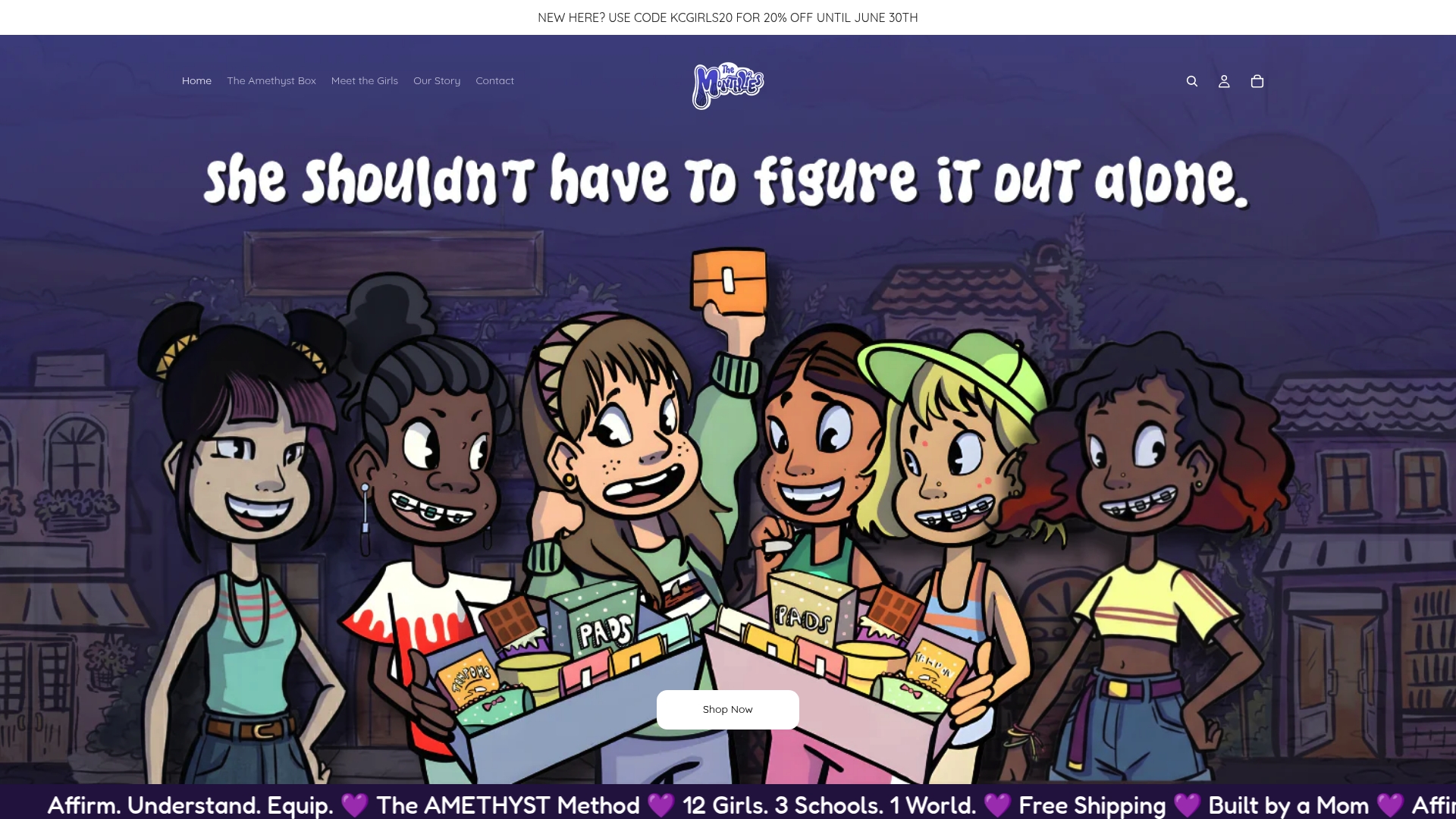
Themonthliesbox created the Amethyst Box specifically for this moment. It is a curated first-period kit built around the Amethyst Method: affirm, understand, and equip. Inside, your daughter finds practical period supplies, affirmations, and educational materials that reinforce everything you have already talked about at home. For families who want to go further, the Monthlies On-The-Go Kit gives her a compact, discreet kit she can carry in her backpack every day. These are not just products. They are confidence, packed and ready to go.
FAQ
What is the best age to start talking about periods?
The best age to start period talks is between 7 and 10 years old. Starting early means your daughter is informed and prepared well before her first period arrives, which typically happens around age 12.
How do I know if my daughter is ready for the period conversation?
Physical signs like breast development, which usually begins around age 9–10, signal that the conversation should deepen. You do not need to wait for her to ask. Starting the discussion before she shows signs is always the right call.
What if my daughter refuses to talk about periods?
Respect her reluctance and try a different approach. Leave an age-appropriate book in her room, or bring up the topic casually during a shared activity. A parent’s support guide can also offer scripts for resistant conversations.
How often should I bring up menstruation?
Period education works best as an ongoing conversation, not a single event. Revisit the topic every few months, especially as your daughter’s body changes, and always after she asks a question or hears something from peers.
What should a first period kit include?
A solid first period kit includes pads or liners, a change of underwear, cleansing wipes, and pain relief for cramps. Compact kits that fit in a backpack give girls confidence at school and away from home.
0 comments