

If you’ve ever wondered why your daughter’s classmate already has her period while your child shows no signs yet, you’re not alone. Understanding why first period age varies so widely is one of the most common concerns parents bring to pediatricians every year. The truth is, there’s no single “right” age. First periods typically happen anywhere between ages 10 and 16, and that entire window is completely normal. What drives those differences is a mix of biology, environment, and factors you might not expect. This guide walks you through all of it.
Table of Contents
- Understanding when periods typically start and why the age varies
- Key factors influencing the age of first period
- How puberty stages connect to the timing of the first period
- When to be concerned and consult a healthcare provider
- A fresh perspective on puberty timing variability and parental support
- Supporting your child through her first period with The Monthlies
- Frequently asked questions
Key Takeaways
| Point | Details |
|---|---|
| Wide normal range | First periods can happen anytime between ages 10 and 16, so timing varies widely and still be normal. |
| Multiple factors influence timing | Genetics, body weight, nutrition, stress, and environment all contribute to when puberty and first periods start. |
| Puberty stages matter | The first period usually occurs 2-3 years after breast development starts, making timing individual. |
| Irregular cycles are common | Periods may be irregular for up to five years after starting, which is normal during adjustment. |
| When to consult doctor | Doctors should evaluate if the first period hasn’t started by age 15 or if irregularities persist beyond a few years. |
Understanding when periods typically start and why the age varies
The medical term for a girl’s first period is menarche (pronounced men-AR-kee). It marks the point when the body has developed enough to begin a monthly cycle. But “developed enough” looks different for every girl, which is exactly why first period age varies so much from one child to the next.
The average age is about 13, though any age between 10 and 16 falls within the normal range. That’s a six-year window. Think about that for a moment. A girl who starts at 10 and a girl who starts at 16 are both perfectly on track developmentally.
Here’s something parents often find reassuring: menarche doesn’t arrive out of nowhere. It typically follows breast development by about two to three years. So if your daughter started showing early signs of puberty at age 9, a first period at 11 or 12 makes complete sense.
What to expect in those early years:
- Menstrual cycles are often irregular for the first one to two years
- Cycle length can range from 21 to 45 days in the first few years
- Flow may be very light or unpredictable at first
- Cramping and mood changes may or may not be present early on
“Puberty is not a single event. It’s a process that unfolds over several years, and menarche is just one milestone along the way.” Think of it less like a switch being flipped and more like a dimmer gradually turning up.
Hormones, specifically estrogen and progesterone, are the key drivers here. The brain signals the ovaries to start producing these hormones, and that signal timing is largely set by genetics. But as we’ll see next, genetics is only part of the picture.
Now that we know the general timing for the first period, let’s explore the factors that influence when this milestone occurs.
Key factors influencing the age of first period
Why does first period age differ so much between girls who seem similar in every other way? The answer is that menarche timing depends on a mix of genetic, environmental, and nutritional factors, not just one cause. These factors interact with each other in ways that make each girl’s timeline genuinely unique.
Here are the main first period onset factors parents should understand:
-
Genetics. The single strongest predictor of when your daughter will start her period is when you started yours. If you got your first period at 11, there’s a good chance she will too. Ask your own mother if you can. That family pattern is real and meaningful.
-
Body weight and composition. Higher BMI is strongly linked to earlier pubertal timing. Body fat produces a hormone called leptin, which signals the brain that the body has enough energy reserves to support reproduction. Girls with higher body fat percentages often reach menarche earlier as a result.
-
Nutrition and energy availability. Girls who are well-nourished tend to reach puberty on the earlier end of the normal range. Girls who are underweight or who have very low caloric intake, such as those involved in intense athletic training, may experience delayed menarche. The body essentially waits until it feels resourced enough.
-
Physical activity levels. High-intensity, high-volume exercise, think competitive gymnastics or long-distance running, can delay the first period by suppressing hormone production. This is not harmful in most cases, but it’s worth knowing.
-
Psychosocial stress. This one surprises many parents. Stress combined with higher BMI may actually accelerate puberty onset. Chronic stress elevates cortisol, which can disrupt the hormonal balance that regulates puberty timing. Girls growing up in high-stress environments sometimes start puberty earlier.
-
Race and ethnicity. Research consistently shows that Black and Hispanic girls tend to reach menarche earlier on average than white or Asian girls. This reflects both genetic differences and social determinants of health.
-
Geographic and environmental factors. Exposure to certain chemicals called endocrine disruptors, found in some plastics and pesticides, may influence hormone activity. This is an area of ongoing research, but it’s worth minimizing unnecessary chemical exposure where you can.
“No single factor determines when your daughter will get her first period. It’s always a combination. That’s exactly why comparing your child to her classmates or cousins tells you very little.”
Pro Tip: Instead of focusing on age, ask your daughter’s pediatrician about her developmental stage. Where she is in breast development and growth is a far more useful indicator of timing than her birthday.
These factors affecting first period age don’t operate in isolation. A girl with a genetic tendency toward early menarche who also has higher body weight and significant stress may start even earlier. A girl with the same genetics but a leaner build and a calm home environment may start later. The interplay is what makes each child’s timeline her own.
With this foundation, let’s see how these factors interplay in real developmental stages.
How puberty stages connect to the timing of the first period
Understanding puberty milestones gives you a much clearer picture of when to expect your daughter’s first period. The variations in menarche age make a lot more sense when you see them in the context of the full puberty sequence.
Puberty typically unfolds over about four years. It begins with thelarche, the start of breast development, which is usually the first visible sign. From there, pubic and underarm hair develop, a significant growth spurt occurs, and then menarche follows. Periods start about two to three years after breast growth begins, which explains why two girls who both started puberty at age 9 might still get their first periods a year or two apart.
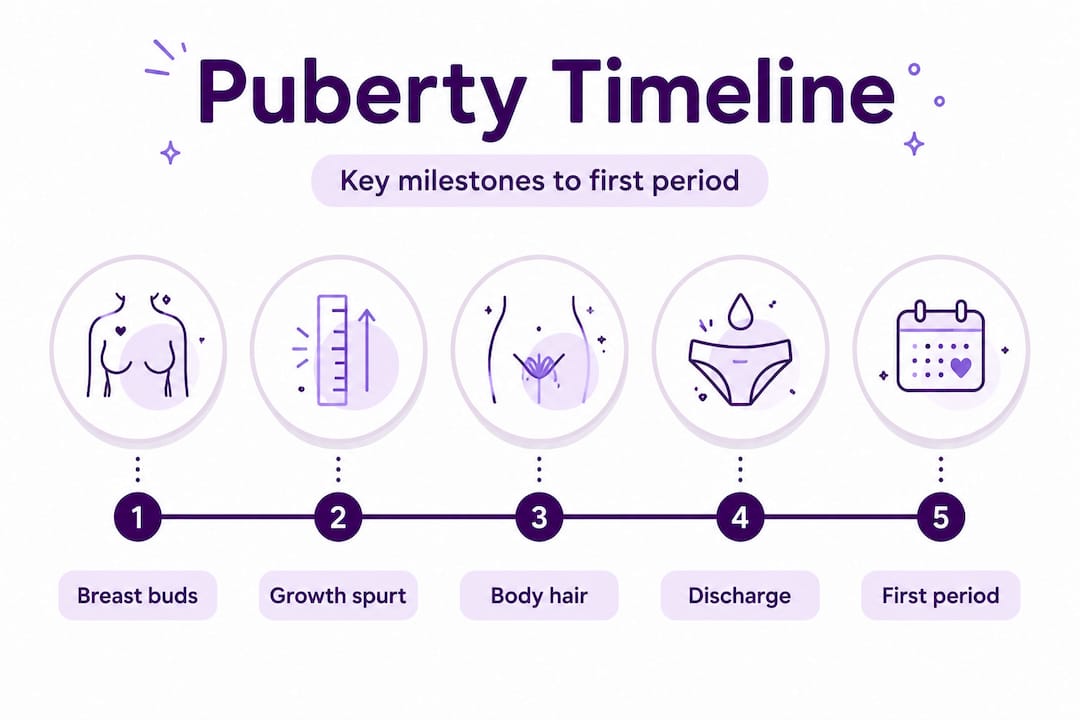
| Puberty milestone | Typical timing | Relationship to first period |
|---|---|---|
| Breast development begins | Ages 8 to 13 | Starts the countdown to menarche |
| Pubic hair appears | Shortly after breast development | Signals hormonal activity is building |
| Growth spurt peaks | About 6 to 12 months before menarche | One of the clearest pre-period signs |
| Vaginal discharge begins | 6 to 12 months before menarche | A reliable early signal |
| First period (menarche) | 2 to 3 years after breast development | The milestone itself |
Tracking breast development and other pre-menarche signs helps parents anticipate the upcoming period far more accurately than watching the calendar. Vaginal discharge, in particular, is a sign many parents miss. When your daughter starts noticing a clear or whitish discharge in her underwear, her first period is likely six months to a year away.
Pro Tip: Start keeping a simple notes app entry or a small journal tracking when you first notice each puberty milestone. This gives you and her pediatrician a concrete developmental timeline, not just a birthday to reference.
This stage-based view also helps you talk with your daughter in a way that feels grounded and calm. Instead of “you might get your period soon,” you can say “your body is right on track, and based on where you are now, we’ll probably see your first period in the next year or so.” That kind of specific, confident reassurance makes a real difference.
Now that we understand puberty milestones, let’s consider how parents can support and know when to seek medical advice.
When to be concerned and consult a healthcare provider
Most first period age differences are completely normal. But there are specific situations where a conversation with a healthcare provider is the right move. Knowing the line between normal variation and something worth checking out gives you confidence, not anxiety.
Reach out to a doctor if:
- Your daughter has not started her period by age 15 (this is called primary amenorrhea)
- Breast development hasn’t begun by age 13
- More than three years have passed since breast development started with no period
- Your daughter has signs of puberty before age 8, which may indicate precocious puberty
- Cycles remain very irregular or very painful more than two to three years after the first period
Seek medical evaluation if menarche hasn’t occurred by age 15 or if early irregularities persist well beyond the first few years. Most of the time, the cause turns out to be benign, such as low body weight, thyroid function, or simple genetic late timing. But ruling those things out is always worth it.
It’s also worth knowing that irregular cycles in the first year or two after menarche are expected, not a red flag. The hormonal system is still calibrating. Cycles may range from 21 to 45 days, and that’s fine. What warrants attention is irregularity that continues past the two to three year mark, or cycles that are extremely painful or very heavy from the start.
“Early consultation isn’t about finding a problem. It’s about getting information. A single appointment can replace months of worry with clarity.”
The emotional side matters here too. If your daughter is anxious about being “last” among her friends, or embarrassed that she started “first,” that’s worth addressing directly. Normalizing the full range of first period age differences, not just the average, is one of the kindest things you can do for her.
A fresh perspective on puberty timing variability and parental support
Here’s something worth saying plainly: our culture has a strange relationship with puberty timing. We’ve somehow landed on the idea that there’s a “right” age, and anything outside that narrow window needs explaining or fixing. That framing does real harm to real kids.
The truth, backed by research on puberty timing, is that puberty reflects a complex interaction of genetics, health, environment, and social factors. There is no single clock. There is no universal schedule. There is only your daughter’s body, doing exactly what it was built to do, on its own timeline.
What we’ve seen, both in the research and in conversations with families, is that the parents who handle this best are not the ones who track the calendar most carefully. They’re the ones who stay curious about their child’s overall wellbeing. How is she sleeping? Is she eating enough? Is she carrying stress she hasn’t named yet? Those questions matter more than her age at menarche.
Supporting her emotionally through puberty is just as important as monitoring physical signs. A girl who feels informed and supported is far more likely to come to you when something feels off, whether that’s a confusing symptom or just a hard day. That open channel of communication is worth more than any checklist.
Tracking developmental milestones rather than calendar age gives you clearer, more actionable guidance. And building a home environment where puberty is talked about openly, without embarrassment or urgency, sets your daughter up to navigate this season of life with real confidence. That’s the goal. Not hitting a specific age. Growing through it, together.
Supporting your child through her first period with The Monthlies
Understanding why first period age varies is the first step. The next step is making sure your daughter feels genuinely prepared, not just informed. That’s exactly what we built The Monthlies to do.

The Monthlies Amethyst Box is designed to walk girls through their first period experience with affirmations, educational materials, and practical supplies, all in one thoughtfully curated package. It’s built around our Amethyst Method: Affirm, Understand, and Equip. Because confidence comes from all three, not just having the right products. For girls who are always on the move, The Monthlies On-The-Go Kit keeps everything she needs close at hand, wherever she is. Visit The Monthlies to explore all our resources and find the right support for your daughter’s unique journey. You’ve got this, and we’ve got you.
Frequently asked questions
What is the normal age range for a girl’s first period?
Most girls get their first period between ages 10 and 16, with age 13 as the average, and any age within that range is considered completely normal.
What factors cause the age of the first period to vary?
Genetics, body weight, nutrition, physical activity, and psychosocial stress all influence timing, and they interact with each other rather than acting as a single cause.
When should parents consult a doctor about delayed or irregular periods?
If a girl hasn’t started her period by age 15 or if cycles stay very irregular more than a few years after menarche, seek medical evaluation to rule out any underlying health concerns.
How can parents track signs that a first period is approaching?
Watch for breast development, a growth spurt, pubic and underarm hair, and vaginal discharge, since periods typically follow breast development by two to three years, with discharge often appearing six to twelve months before menarche.
Does higher body weight affect when a girl starts her period?
Yes. Higher BMI is linked to earlier puberty onset because body fat produces leptin, a hormone that signals the brain the body is ready to begin the reproductive cycle.
0 comments