

The mother-daughter period conversation is one of the most confidence-shaping exchanges a parent can have, and starting it early makes all the difference. Many parents feel caught off guard, unsure whether their daughter is ready or whether they have the right words. The truth is, there is no perfect script. What matters is that you talk daughter about periods before she hears incomplete or frightening information from peers. This guide walks you through the biology, the timing, the language, and the practical preparation that turns an awkward topic into an ongoing, trust-building conversation.
What every parent should know before talking about periods
Menstruation is the monthly shedding of the uterine lining, triggered by hormonal changes when a fertilized egg does not implant. Understanding this process clearly is the first step to explaining it simply. You cannot reassure your daughter if you are uncertain yourself.
The physical basics parents need
First periods typically arrive anywhere between ages 9 and 16, with the average falling around 12 to 13. That wide range means some girls in fourth grade are already menstruating while others in eighth grade have not started yet. Neither is abnormal. Menstruation typically begins two to three years after puberty starts, with bleeding lasting three to seven days and cycles ranging from 21 to 35 days. Early cycles are often irregular, and it can take one to two years before a consistent rhythm develops. That variability is normal, and your daughter needs to hear that from you before she worries.
Physical signs that a first period is approaching include:
- Breast development beginning, often the earliest sign
- Vaginal discharge, which typically appears six to twelve months before menarche
- A noticeable growth spurt in height
- Mood changes and increased emotional sensitivity
- Body hair growth in the underarm and pubic areas
These physical signs typically give parents a six to twelve month window to prepare. That is your runway. Use it.
When to call a doctor
Seek medical advice if your daughter has no period by age 15, experiences severe cramps that over-the-counter medications do not relieve, has very heavy bleeding, or still has irregular cycles after two years of menstruating. Sharing these specific triggers with your daughter gives her a concrete framework for knowing when something is worth mentioning to you or a doctor.
Pro Tip: Use correct anatomical terms like “uterus,” “vagina,” and “menstruation” from the start. Avoiding these words signals that the topic is shameful, which is the opposite of what you want.
| Topic | What to tell your daughter |
|---|---|
| Cycle length | Periods come every 21 to 35 days, but early cycles are often irregular |
| Bleeding duration | Most periods last three to seven days |
| Flow variation | Light to heavy flow is normal; soaking through a pad every hour is not |
| Cramps | Mild cramping is common; severe pain that stops daily activity needs a doctor |
| Discharge | Clear or white discharge before a period starts is normal and healthy |
How to talk to your daughter about periods: timing and approach
The biggest mistake parents make is waiting for one defining conversation. Ongoing conversations with simple baseline information are far more effective than a single lecture. Children absorb information gradually, and their questions evolve as they grow. Match your answers to where she is, not where you think she should be.
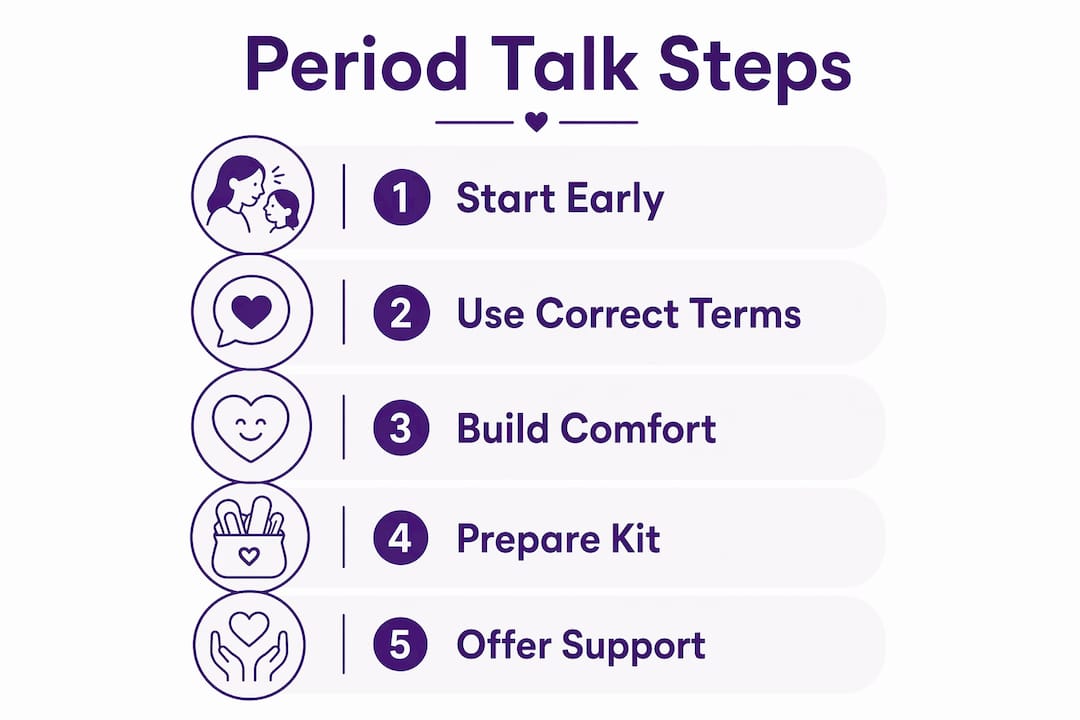
Here is a practical sequence for building the conversation over time:
- Start at ages 6 to 7 with simple facts. Explain that bodies change as people grow, and that one of those changes is called a period. Keep it brief and matter-of-fact. Conversations starting this early build understanding gradually and reduce the shock factor later.
- Use teachable moments. A tampon commercial, a scene in a movie, or a question from a friend at school are all natural openings. You do not need to manufacture a formal sit-down talk.
- Use neutral, accurate language. Phrases like “some people get periods as part of growing up” keep the tone light and factual. Using correct body terms from the beginning normalizes the topic and removes the sense that it is something to be whispered about.
- Let her lead with questions. Pause after sharing information and ask, “Does that make sense? Do you have any questions?” Listening actively tells her that her curiosity is welcome.
- Avoid shame triggers. Never react with embarrassment, laughter, or frustration. Reducing shame by keeping your tone calm and open is what makes her feel safe enough to come back with harder questions later.
- Revisit the topic regularly. A conversation at age 8 is not the same as one at age 11. Return to the subject as she grows and her understanding deepens.
Pro Tip: If you feel awkward, say so. “This feels a little weird to talk about, but it’s too important not to” is honest and relatable. It also models the kind of openness you want her to have.
How to prepare your daughter emotionally and practically
A calm, informed parent shapes how a daughter feels about her first period more than any book or video. Mixed emotions at menarche are completely normal. She might feel proud, embarrassed, excited, or scared, sometimes all at once. Your job is to meet every reaction with reassurance, not interpretation.

Building a period starter kit
Practical preparation removes a huge source of anxiety. Put together a small kit before her first period arrives so she is never caught off guard. A good starter kit includes:
- Pads in different absorbencies (light, regular, and heavy)
- Panty liners for lighter days or discharge
- Pain relief medication like ibuprofen or acetaminophen
- A small pouch she can carry in her school bag
- A change of underwear kept in her locker or bag
- Wipes for freshening up when a bathroom sink is not nearby
Having products ready in advance reduces fear significantly when bleeding occurs unexpectedly. Walk her through how to use a pad. Practice together if she is comfortable with that. Normalizing the product removes the mystery.
Emotional support strategies
Encourage a positive body image by framing menstruation as a sign of a healthy, growing body, not a burden. Involve other trusted family members where appropriate so she does not feel isolated. Some families find that a small celebration of menarche, a special dinner or a meaningful gift, helps reframe the milestone as something to feel good about rather than dread.
| Approach | What it communicates |
|---|---|
| Reacting with calm reassurance | “This is normal and you are safe” |
| Preparing a starter kit together | “You are ready and supported” |
| Using accurate language consistently | “There is nothing shameful about this” |
| Celebrating the milestone | “This is something to feel proud of” |
| Involving trusted family members | “You are not alone in this” |
A pre-teen self-care routine that includes gentle movement, warm compresses for cramps, and adequate rest helps her feel in control of her body from day one.
Common challenges parents face when discussing menstruation
Even well-prepared parents hit walls. Knowing what to expect makes those moments easier to navigate.
She refuses to talk. Some girls shut down out of embarrassment or because they have already absorbed the message that periods are gross or private. Different kids respond differently, and some need an indirect approach. Try sharing a book, a podcast, or a video together instead of a face-to-face conversation. The information still lands, and the pressure is lower.
She asks something you cannot answer. That is fine. “I don’t know, but let’s find out together” is a powerful response. It models intellectual honesty and keeps the conversation collaborative rather than one-sided.
She has heard misinformation from friends. Let her lead with questions and pause to gauge what she already believes before correcting anything. Jumping straight into corrections can feel like a lecture. Ask, “Where did you hear that?” and then gently offer accurate information.
She is scared. Fear usually comes from the unknown. Walk through what to expect on her first period day in concrete terms: what the blood looks like, how much is normal, and exactly what to do. Specificity is more comforting than vague reassurance.
Pro Tip: Keep the door open after every conversation. End with “You can always come to me with questions, no matter what.” Say it every time. Repetition makes it believable.
Key takeaways
The most effective way to talk to your daughter about periods is through early, ongoing conversations that combine accurate biology, calm emotional support, and practical preparation before her first period arrives.
| Point | Details |
|---|---|
| Start early | Begin simple conversations at ages 6 to 7, long before the first period arrives. |
| Use accurate language | Correct anatomical terms normalize menstruation and remove shame from the topic. |
| Prepare a starter kit | Having pads, pain relief, and a carry pouch ready reduces fear when bleeding starts. |
| Stay calm and consistent | A parent’s calm reaction shapes how a daughter feels about her own body. |
| Keep the conversation going | One talk is never enough. Return to the topic as she grows and her questions change. |
What I have learned from guiding families through this conversation
Here is what I know after working with hundreds of families at Themonthliesbox: the parents who worry most about saying the wrong thing are almost always the ones who do the best job. The worry means you care. And caring is what your daughter will remember.
The families who struggle most are not the ones who stumble over words. They are the ones who wait too long, hoping the school will handle it or that their daughter will just figure it out. She will figure it out, but without your voice in the mix, she will fill the gaps with whatever her peers or the internet offer. That is a gap worth closing.
What actually works is smaller than most parents expect. A two-minute conversation while driving to soccer practice. A quick, calm response when she spots a tampon in your bag. A matter-of-fact answer when she asks why her friend missed gym class. Those small moments, stacked over years, build the kind of trust where she comes to you first when something feels wrong or confusing. That is the goal. Not a perfect talk. Just an open door.
— Themonthliesbox
Ready to prepare your daughter with confidence?
At Themonthliesbox, we built the Amethyst Method specifically for this moment in a girl’s life. It moves through three phases: affirm, understand, and equip. Each phase is designed to meet her where she is emotionally and practically.
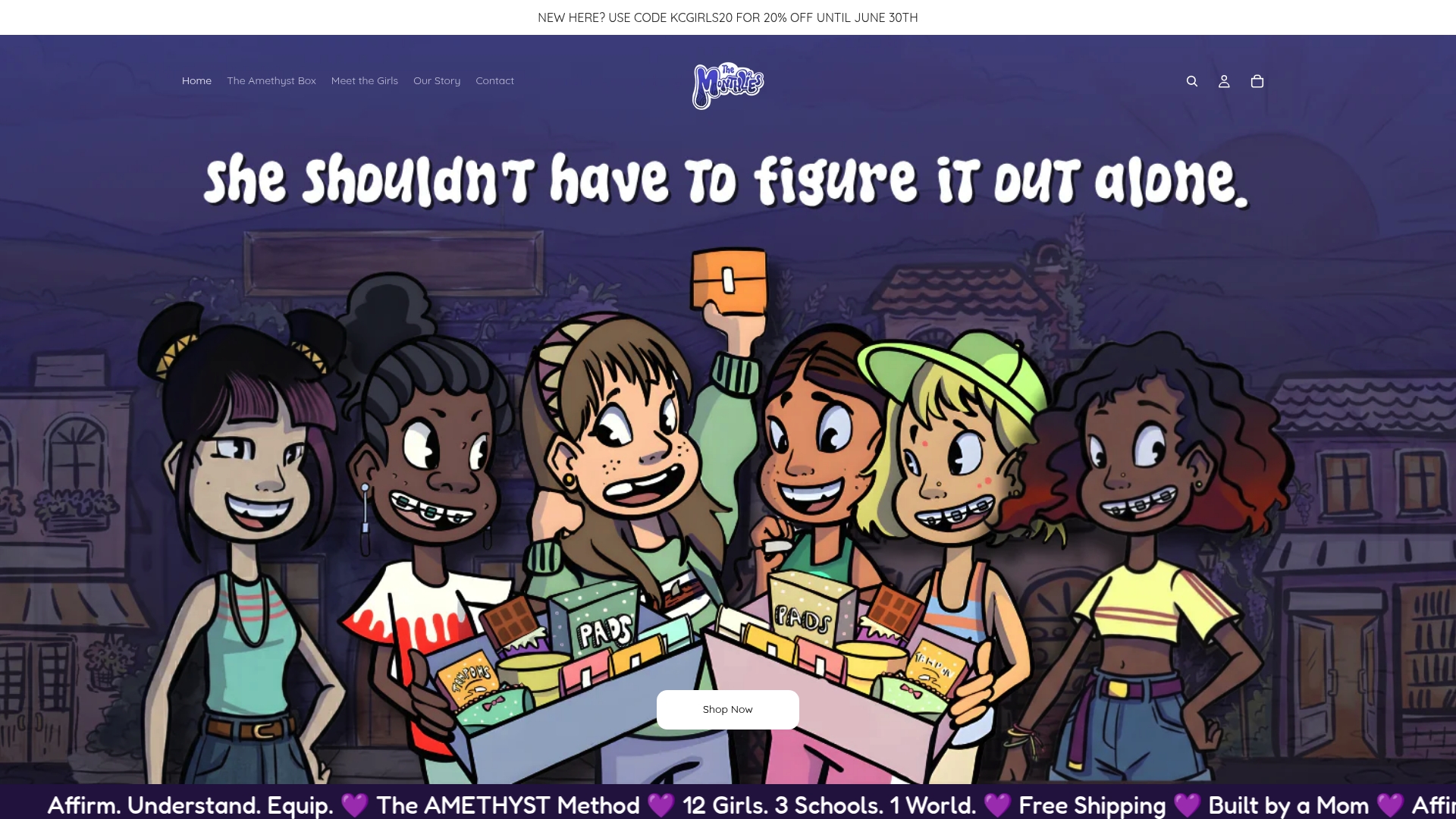
The Amethyst Box brings all three phases together in one thoughtfully curated kit. It includes affirmations, educational materials, and practical period supplies, everything she needs to feel ready and supported before her first period arrives. For girls who are already menstruating, the On-The-Go Kit keeps essentials organized and accessible for school, sports, and travel. Both kits are designed to make this milestone feel like something to grow through, not something to fear. Welcome to LavenHaven. We have been waiting for you.
FAQ
When should I start talking to my daughter about periods?
Start conversations as early as ages 6 to 7 with simple, age-appropriate facts. Building understanding gradually over years is far more effective than one big talk right before her first period.
What are the signs that my daughter’s first period is coming?
Breast development, vaginal discharge, a growth spurt, and mood changes typically appear six to twelve months before menarche. These signs give parents time to prepare practically and emotionally.
How do I explain periods to a young daughter without scaring her?
Use calm, accurate language and frame menstruation as a normal, healthy part of growing up. Avoid vague or dramatic descriptions. Specific, matter-of-fact information is always more reassuring than general statements.
What should I include in a first period kit?
A starter kit should include pads in multiple absorbencies, panty liners, ibuprofen or acetaminophen, a small carry pouch, and a spare pair of underwear. Having these ready before her first period removes a major source of anxiety.
When should my daughter see a doctor about her period?
Seek medical advice if she has no period by age 15, experiences severe cramps that do not respond to over-the-counter medication, has very heavy bleeding, or still has irregular cycles after two years of menstruating.
0 comments