

Menstrual support in school is defined as the combination of product access, emotional guidance, and education that allows menstruating students to attend and participate fully without fear or embarrassment. A 2026 BMC Public Health study found that 49 adolescent girls reported negative school experiences tied directly to lack of product access and bathroom restrictions. That finding confirms what many parents and educators already sense: to support students first period school environments must do more than stock a bathroom cabinet. The right approach covers supplies, communication, and school-wide policy working together.
What supplies and tools should be prepared for a student’s first period at school?
The most practical starting point is a personal period kit your daughter carries every day. A small, discreet pouch in her backpack or locker removes the panic of being caught unprepared. Stock it with the basics and refresh it regularly.
A well-stocked kit includes:
- Pads in light and regular absorbency (most first periods are light)
- Individually wrapped wipes for quick cleanup
- A spare pair of underwear in a sealed zip bag
- Small disposal bags for used products
- A change of leggings or shorts if space allows
Product variety matters. Students with heavier flows or longer school days need options beyond a single pad size. WRDSB student surveys from 2025–2026 show that students want wider product size variety and more accessible locations beyond bathrooms. That feedback reflects a real gap between what schools stock and what students actually need.
| Supply | Purpose | Where to keep it |
|---|---|---|
| Light and regular pads | Covers varying flow levels | Backpack pouch |
| Individually wrapped wipes | Discreet cleanup | Backpack pouch |
| Spare underwear (sealed bag) | Leak backup | Backpack or locker |
| Disposal bags | Hygienic product removal | Backpack pouch |
| Comfort snack or heat patch | Cramp relief | Backpack side pocket |
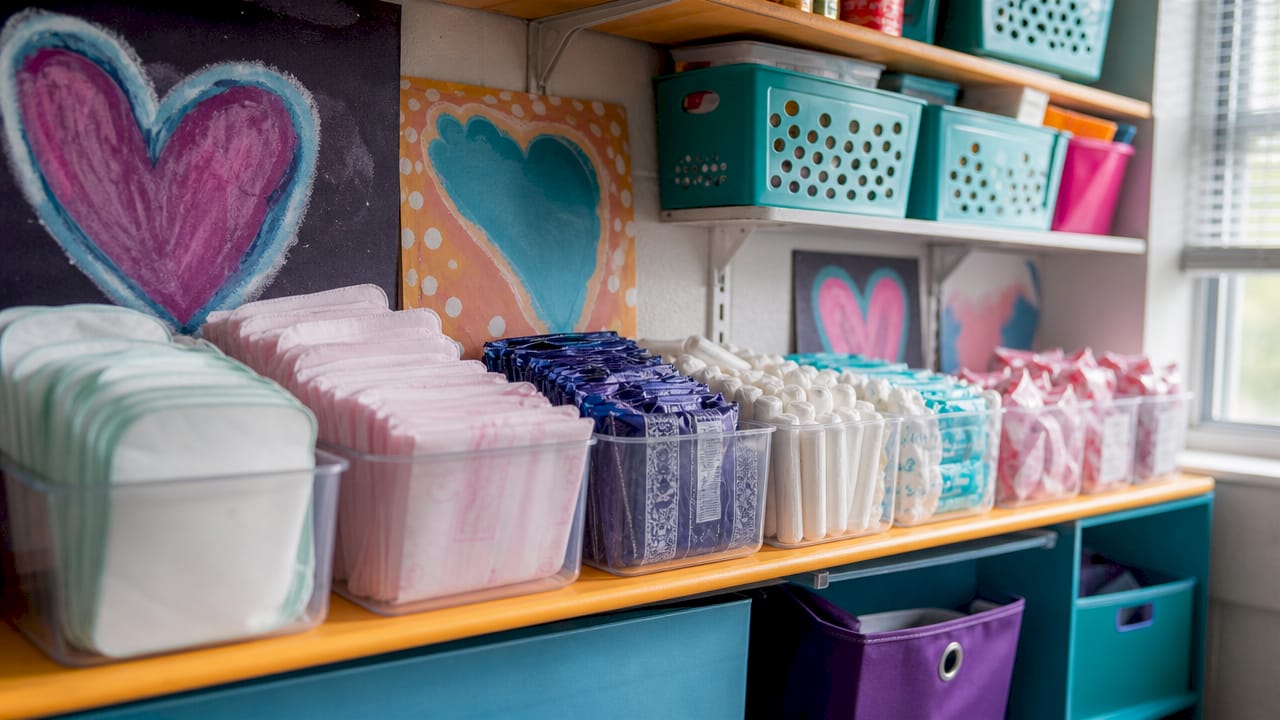
Schools can also set up a necessities station with spare clothes and comfort items in the nurse’s office or a trusted teacher’s classroom. This proactively reduces anxiety from unexpected leaks or incidents. It signals to students that the school is prepared and that they are not alone.
Pro Tip: Pack two kits: one for the backpack and one stored with the school nurse or a trusted adult. That way, a forgotten bag never becomes a crisis.
How can schools ensure discreet and stigma-free access to menstrual products?
Free, easy access to period products is the single most effective structural change a school can make. Experts recommend placing products in bathrooms, classrooms, and staff offices using unlabeled containers or vending machines so students can take what they need without asking. Asking draws attention. Discreet access removes the barrier entirely.
Effective access strategies include:
- Unlabeled baskets in bathroom stalls (not just on counters)
- Vending machines in gender-neutral or all-student restrooms
- A small supply kept in every classroom teacher’s desk drawer
- Sanitary disposal bins in every bathroom stall, not just one per restroom
- Frequent restocking schedules so supplies are never empty when needed
Programs like WRDSB’s initiative, which plans to supply 650,000 menstrual products over three years, show what systemic commitment looks like. That scale eliminates the equity gap between students who can afford products and those who cannot. Some regions are going further. In 2026, Bogotá, Colombia integrated period underwear into standard school uniforms to promote dignity and reduce absenteeism. That model treats menstrual health as a baseline right, not an afterthought.
Bathroom access itself is part of the equation. A silent or non-verbal pass system, such as a token or a two-feet rule, lets students leave class without announcing why. It preserves dignity and removes the social cost of asking out loud.
Pro Tip: Train every teacher to keep a small, unmarked supply in their desk. A student who needs a pad during math class should never have to walk to the nurse’s office across the building.
What emotional and educational supports help students during their first period at school?
Product access alone does not resolve the anxiety many girls feel. Open, age-appropriate conversation led by trained staff is equally critical. Teachers often lack training in menstrual health, which means students frequently receive insufficient support even when products are available. Training teachers changes that dynamic.
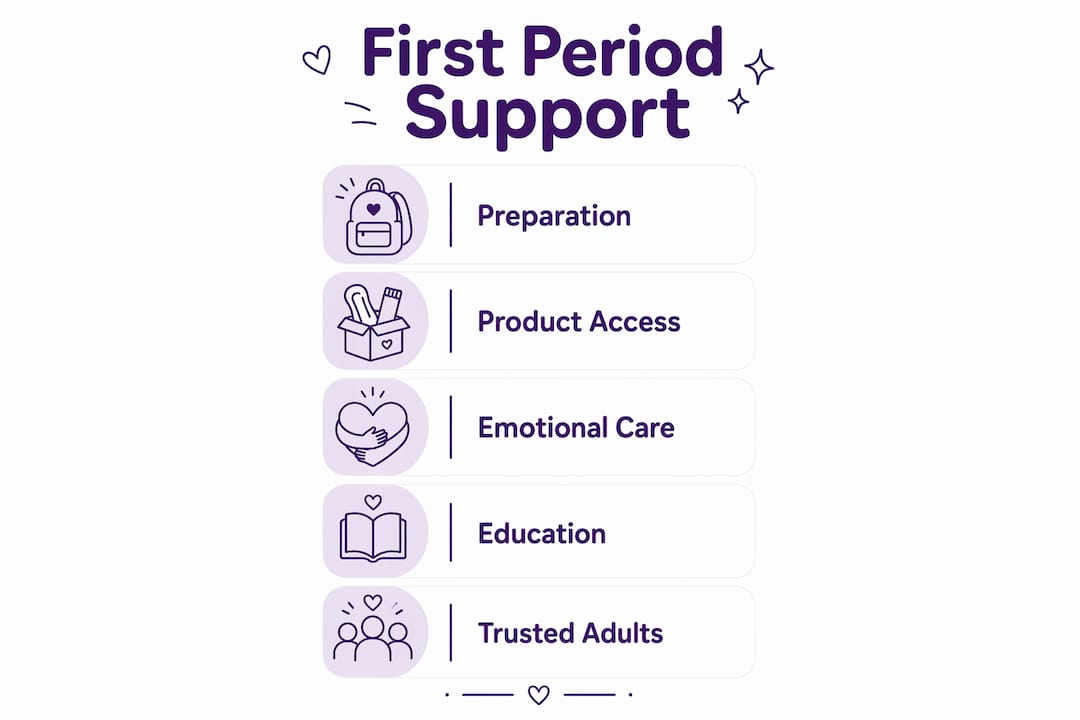
Students benefit most from having a designated trusted adult at school, such as a counselor or nurse, who they can approach comfortably about period-related concerns. That person does not need to be a health professional. They need to be approachable, informed, and discreet. Knowing that person exists before the first period arrives reduces anxiety significantly.
The Victorian Department of Education recommends integrating menstrual health into the standard health curriculum, covering hygiene management and guidance on when to seek medical help. Including all genders in that education normalizes the topic and reduces the stigma that makes girls feel ashamed in the first place.
Educator do’s and don’ts:
- Do respond calmly and privately when a student asks for help
- Do use accurate, non-embarrassing language (period, menstruation, not “that time of the month”)
- Do check in quietly after an incident to make sure the student feels okay
- Don’t announce to the class why a student is leaving the room
- Don’t make a student wait or ask multiple adults before getting help
- Don’t treat a period-related request differently from any other health need
Classroom culture matters too. When teachers normalize periods through curriculum and calm responses, students follow that lead. A girl who sees her teacher handle a period question without flinching learns that her body is not something to hide.
How to prepare and support students practically on their first period day at school
Preparation before the first period arrives is the most powerful thing a parent or educator can do. A student who has already talked through what to expect, practiced using a pad, and knows who to go to at school will handle the moment with far more confidence. Read through this parent’s guide to first periods to build that foundation at home first.
Step-by-step for the first period day at school:
- Stay calm. A student picks up on adult panic. A steady, matter-of-fact response sets the tone.
- Give her privacy. Walk her to the bathroom or nurse’s office without an audience.
- Provide a product and show her how to use it if she has not practiced at home.
- Offer a change of clothes if there has been a leak. Keep this discreet and quick.
- Check in privately later in the day. A simple “How are you feeling?” goes a long way.
- Contact the parent or guardian if the student is distressed or needs to go home.
For parents, the readiness checklist looks like this:
| Readiness step | Action |
|---|---|
| Talk about periods before they start | Use age-appropriate books or guides to explain what to expect |
| Build a period kit together | Let her choose her products so she feels ownership |
| Identify her trusted adult at school | Name the person she should go to if something happens |
| Practice using products at home | Reduces panic when she needs to use one alone |
| Share the school’s bathroom pass system | So she knows she can leave class without explaining herself |
Girls who feel prepared before their first period are far more likely to stay calm during the moment itself. Preparation is not about predicting every detail. It is about removing the fear of the unknown.
Key Takeaways
Effective support for students during their first period at school requires product access, trained adults, open education, and personal preparation working together as a system.
| Point | Details |
|---|---|
| Stock a personal period kit | A discreet backpack pouch with pads, wipes, and spare underwear prevents panic. |
| Use silent bathroom pass systems | Non-verbal tokens let students leave class without announcing their needs. |
| Designate a trusted adult at school | A named counselor or nurse gives students a safe, private person to approach. |
| Integrate menstrual health into curriculum | Teaching all students normalizes periods and reduces stigma school-wide. |
| Prepare students before the first period arrives | Practicing at home and naming a school contact builds real confidence. |
What I’ve learned from watching schools get this right (and wrong)
Stigma is the real barrier. Not the products, not the policies. Stigma.
I have seen schools with fully stocked bathrooms where girls still missed class because no one had ever told them it was okay to ask for help. The products sat there unused because the culture around them was still shame-based. That gap between having resources and actually using them is where most schools fail.
The schools that get it right treat menstrual health like any other health need. They train teachers the same way they train them to respond to a student with a headache or a sprained ankle. They name a trusted adult and make sure every student knows who that person is before they ever need them. They include menstrual health in the health curriculum without treating it as a special or sensitive topic separate from everything else.
What I find most encouraging is that the solutions are not expensive or complicated. A token-based bathroom pass system costs nothing. A basket of pads in a classroom drawer costs very little. A five-minute conversation with a student before her first period costs nothing at all. The schools that do these things well are not the ones with the biggest budgets. They are the ones where adults decided that this mattered.
Menstrual health belongs in the same category as nutrition, sleep, and mental health. When schools treat it that way, students show up, participate, and feel like they belong. That is the whole point.
— The
Themonthliesbox: first period preparedness, built for school days
Every girl deserves to walk into school feeling ready, not worried. Themonthliesbox was built exactly for that moment.
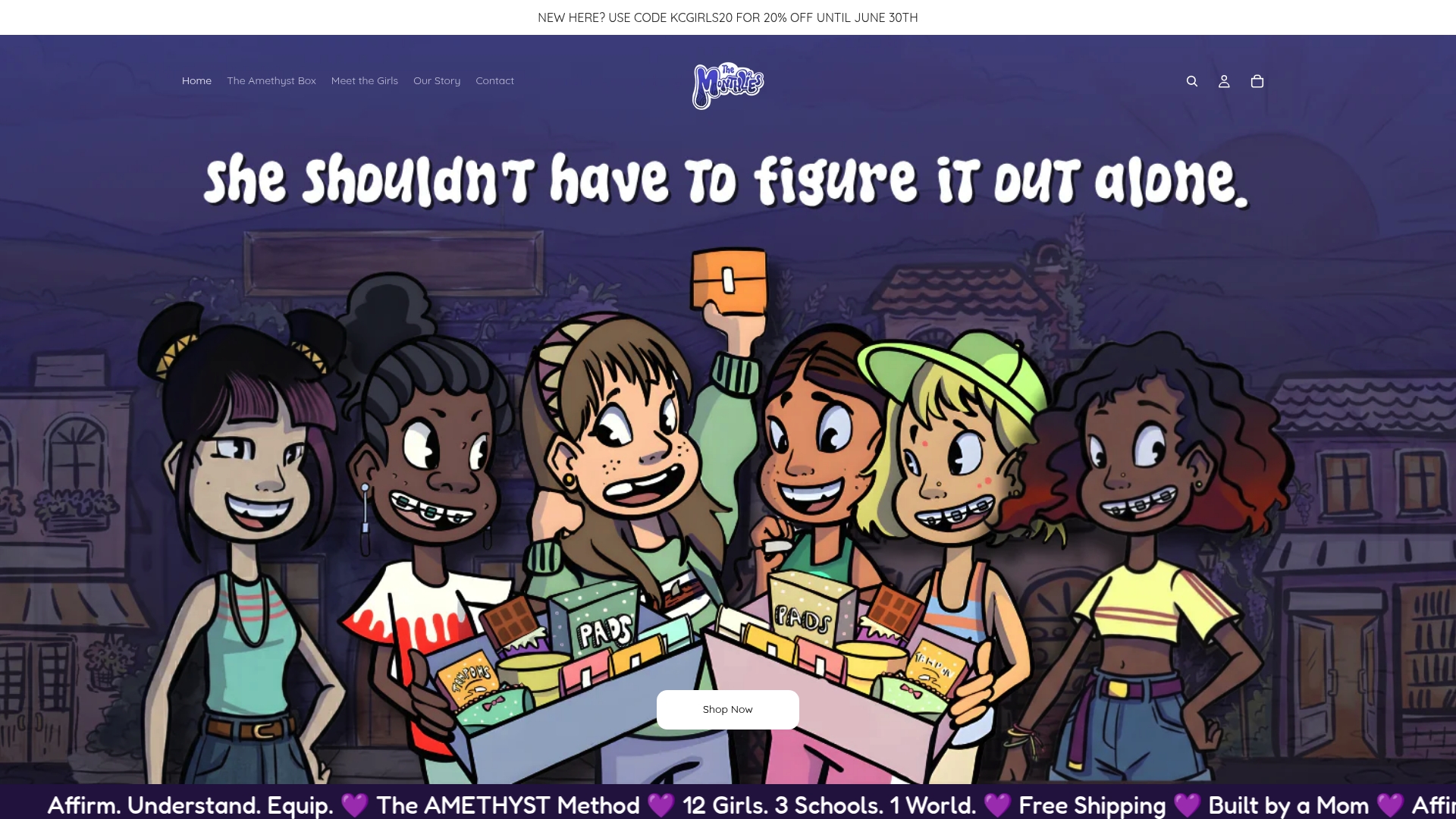
The Amethyst Box is Themonthliesbox’s signature first period kit, designed to affirm, educate, and equip young girls before their period arrives. It includes practical supplies, affirmations, and educational materials built around the Amethyst Method. For school days specifically, the On-The-Go Kit fits neatly into any backpack and keeps a student covered without drawing attention. Parents who want ongoing support can also explore the Bestie Bundle, which pairs two boxes for siblings or friends going through puberty together. Themonthliesbox is the friend group every girl deserves, right there in her bag.
FAQ
What should a student do if her first period starts at school?
She should go to the bathroom, visit the school nurse, or approach her designated trusted adult for a product and privacy. Staying calm and knowing who to ask makes the moment manageable.
What period products should a student keep in her school bag?
A light pad, individually wrapped wipes, a spare pair of underwear in a sealed bag, and small disposal bags cover most first-period situations at school.
How can teachers support menstruating students without embarrassing them?
Teachers can use a silent pass system and keep a small, unmarked supply of products in their desk. Responding calmly and privately is the most effective approach.
Should schools provide free menstrual products?
Yes. Programs like WRDSB’s initiative to supply 650,000 products over three years show that free access reduces equity gaps and improves attendance.
How can parents prepare their daughter for her first period at school?
Build a period kit together, name her trusted adult at school, and practice using products at home. Review a first period school guide with her so she knows exactly what to expect before it happens.
0 comments