

The earliest, most reliable signs your daughter is entering puberty are breast budding, a noticeable growth spurt, and new pubic or underarm hair. Body odor, acne, vaginal discharge, and emotional shifts like mood swings and increased sensitivity round out the picture. Most girls begin showing these changes somewhere in childhood or early adolescence, and the first period typically follows about 2–3 years after breast budding starts.
Here is a quick snapshot of what to watch for:
- Breast budding (thelarche): Small, sometimes tender bumps under one or both nipples, often the very first sign
- Growth spurt: Clothes and shoes that suddenly stop fitting
- Pubic and underarm hair: Fine hair appearing in new places
- Body odor: Stronger sweat smell, especially after activity
- Acne: Oilier skin on the face, back, or chest
- Vaginal discharge: Clear or white, usually starting 6–12 months before the first period
- Mood swings and emotional sensitivity: Bigger feelings, more tears, more need for privacy
If you notice any signs significantly earlier than usual, or your daughter shows no signs by an age when puberty typically occurs, call her pediatrician. Otherwise, your most useful next steps are a calm, matter-of-fact conversation and a small supply kit tucked into her backpack before she needs it.
Table of Contents
- When does puberty typically start for girls?
- What physical changes in teenage girls signal puberty is underway?
- How do emotional changes during puberty show up at home?
- What is the typical order and timeline of puberty changes?
- When should you call the doctor about puberty signs?
- How to talk with your daughter about these changes
- A practical preparation checklist for parents
- Key Takeaways
- Puberty is gradual, and you are more ready than you think
- The Amethyst Box makes first-period prep feel supported, not stressful
- Useful sources for further reading
When does puberty typically start for girls?
Most girls begin puberty between ages 8 and 13, with the first period arriving around age 12 on average in the United States. That five-year window is wide by design. Normal is a big category, and your daughter’s timeline is her own.
Two terms are worth knowing:
- Precocious (early) puberty: Any visible pubertal sign appearing before age 8. This warrants a pediatric evaluation to rule out hormonal or other medical causes.
- Delayed puberty: No signs at all by age 13. Also worth a doctor’s visit, though it is often simply a family pattern.
Several factors shape when puberty begins:
- Genetics: The single strongest predictor. If you started early or late, your daughter likely will too.
- Body weight and nutrition: Higher body fat is associated with earlier onset; chronic undernutrition can delay it.
- Chronic illness: Certain conditions affecting the thyroid, kidneys, or adrenal glands can shift timing.
- Environmental exposures: Some research points to endocrine-disrupting chemicals as a possible contributor to earlier onset, though the picture is still evolving.
Pro Tip: Start a simple log when you first notice a change. A note in your phone with the date and a brief description (“noticed breast budding, left side, slightly tender”) gives your pediatrician a clear timeline and takes the guesswork out of “when did this start?”
What physical changes in teenage girls signal puberty is underway?
Puberty follows a fairly predictable sequence, driven by rising levels of LH and FSH from the pituitary gland that trigger sex-hormone production in the ovaries. Each physical change below has its own timing and its own set of parenting moments.
Breast budding. This is the first sign for most girls. You may notice a small, coin-sized bump directly under one or both nipples. It can be tender to the touch, and it is completely normal for one side to appear before the other or to feel larger. Asymmetry at this stage is common and almost never a medical concern. A soft, wire-free bralette or training bra often becomes welcome around this time, and asking your daughter how she feels about her body before buying anything goes a long way.
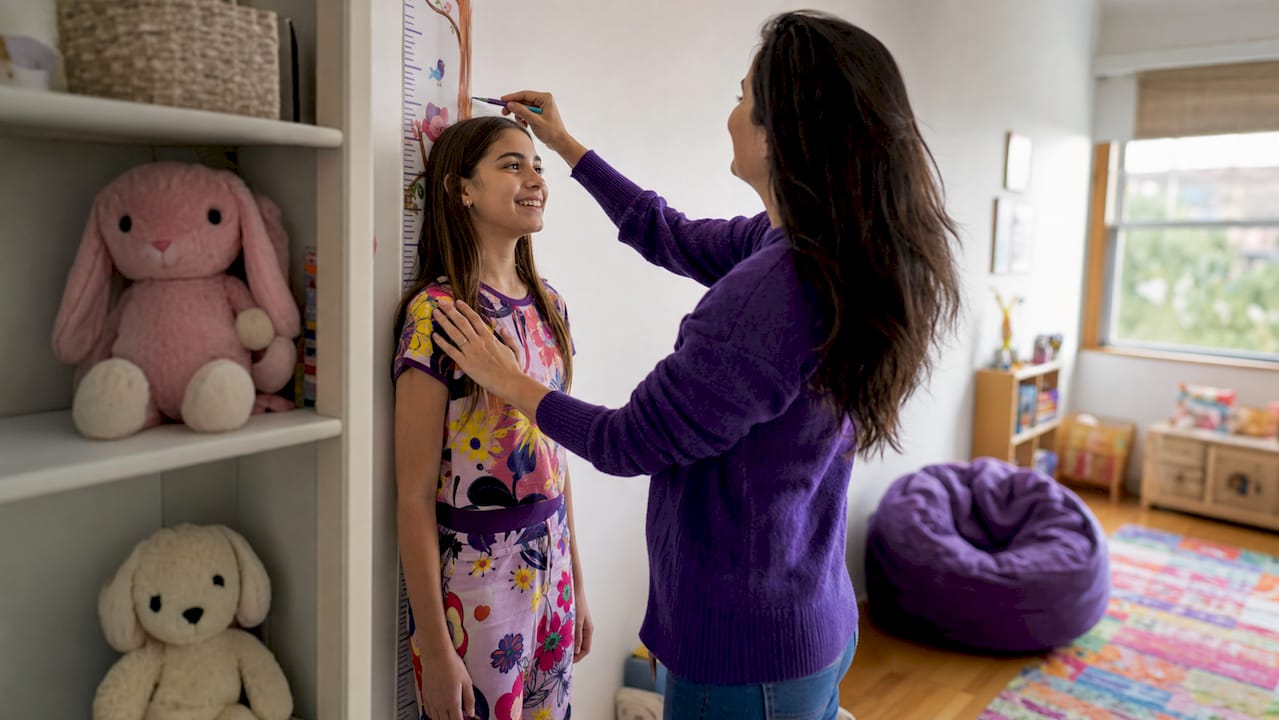
Growth spurt. Height can increase by more than 3 inches in a single year during peak puberty. You will notice it in pants that are suddenly too short, shoes that no longer fit, and a general sense that she looks taller every week. The growth spurt typically follows breast budding by several months.
Pubic and underarm hair. Fine, straight pubic hair along the labia usually appears in Stage 2 of puberty, becoming coarser and curlier through Stages 3 and 4. Underarm hair tends to follow a bit later. About 15% of girls show pubic hair as their very first visible sign, before any breast development. Both patterns are normal.
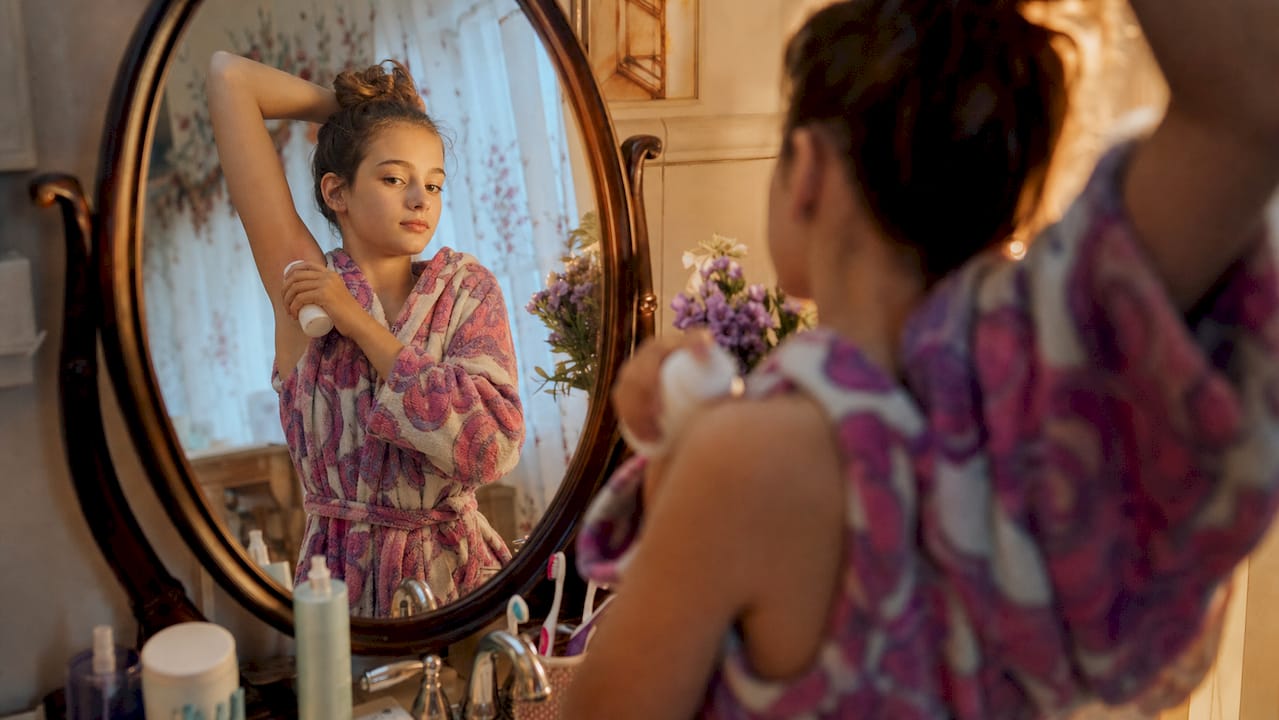
Body odor. Sweat glands become more active with rising hormones, and the result is a noticeably stronger smell, especially after physical activity. Introducing a gentle deodorant early, framed as a normal part of growing up rather than a hygiene problem, keeps the conversation positive.
Acne. Increased oil production during puberty commonly leads to breakouts on the face, chest, and back. A simple, fragrance-free cleanser used twice daily is a good starting point. If breakouts are severe or painful, a pediatrician or dermatologist can help.
Vaginal discharge. A small to moderate amount of clear or white discharge that does not smell foul is a normal estrogen response. It typically begins 6–12 months before the first period and is one of the most reliable signals that menarche is approaching. Discharge that is yellow, green, gray, or has a strong odor may indicate an infection and deserves a doctor’s visit.
First period (menarche). The first period usually arrives about 2–3 years after breast budding begins. Flow can range from light spotting to a moderate bleed, and the color may be bright red, dark brown, or anywhere in between. Early cycles are often irregular for the first one to two years, which is completely normal.
“Menstruation is one milestone in a sequence. Early cycles are often irregular and typically normalize over time, but parents should seek care for excessively heavy bleeding or when periods interfere with daily life.” — Johns Hopkins Medicine
| Physical Sign | Typical Timing | What Parents Notice |
|---|---|---|
| Breast budding | Ages 8–13 (Stage 2) | Tender bump under nipple; asymmetry is normal |
| Pubic hair | Shortly after breast budding | Fine hair along labia; coarsens over time |
| Growth spurt | Stages 2–3 | Rapid height gain; clothes stop fitting |
| Body odor | Stage 2 onward | Stronger sweat smell after activity |
| Acne | Stage 3 onward | Oily skin; breakouts on face, back, chest |
| Vaginal discharge | ~6–12 months before period | Clear or white; no strong odor |
| First period | ~2–3 years after breast budding | Light to moderate flow; irregular at first |
How do emotional changes during puberty show up at home?
Hormones do not just change the body. Rising estrogen and progesterone levels directly affect the brain’s emotional processing centers, which is why your daughter may seem like a completely different person some afternoons. That is not a character flaw. It is biology, and it is temporary.
Common emotional and social signs to expect:
- Mood swings: Tears over something small, followed by laughter ten minutes later
- Increased sensitivity: Feeling criticized or embarrassed more easily than before
- Desire for privacy: Closing doors, wanting more alone time, less interest in family activities
- Social shifts: Friendships becoming more intense and more important than family time
- Withdrawal from parents: Preferring to talk to friends rather than you, which is developmentally healthy in small doses
Increased hormonal activity often coincides with more intense emotions and possible anxiety. The goal is not to eliminate those feelings but to stay connected enough that she knows you are safe to talk to.
What helps:
- Stay calm when she is not. Your steadiness is the anchor.
- Acknowledge feelings before offering solutions. “That sounds really frustrating” lands better than “here is what you should do.”
- Keep small, low-pressure conversations going regularly rather than waiting for a big moment.
- Respect her growing need for privacy while staying present.
When to pay closer attention. Moodiness is normal. These signs are not:
- Marked withdrawal from all friends and family for more than two weeks
- Significant changes in appetite or sleep patterns
- Talk of hopelessness, worthlessness, or self-harm
- Refusing to attend school or activities she previously enjoyed
If you notice any of these, reach out to her pediatrician or a licensed mental-health professional. You do not need to be certain something is wrong to make that call.
What is the typical order and timeline of puberty changes?
Breast budding usually comes first, followed by pubic hair, a growth spurt, and then the first period, typically within 2–3 years of when breast development began. That sequence is the most common, but it is not the only one. Some girls experience pubic hair before any breast changes, and the pace between stages varies considerably.
| Stage | Typical Age Range | Key Changes |
|---|---|---|
| Stage 1 | Before age 8 | No visible changes; ovaries and adrenal glands maturing internally |
| Stage 2 | Ages 8–13 | Breast budding, scant pubic hair, early body odor, height gain of ~2¾ inches/year |
| Stage 3 | Ages 9–13 | Continued breast growth, coarser pubic hair, underarm hair, growth spurt over 3 inches/year, acne |
| Stage 4 | Ages 10–15 | Breasts more developed, pubic hair dense, first period typically arrives |
| Stage 4 | Ages 12–17 | Adult body proportions; most girls reach peak height by age 15 |
The interval between the first visible sign and the first period averages about 2–3 years. Genetics and ethnicity both influence where a girl falls within these ranges. Research consistently shows that Black and Hispanic girls in the United States tend to begin puberty slightly earlier on average than white or Asian girls, though all groups overlap considerably and individual variation is the rule, not the exception.
When should you call the doctor about puberty signs?
Most puberty timelines do not require a medical visit beyond routine well-child checkups. A few situations do. Knowing the difference saves you both unnecessary worry and unnecessary delay.
Call or schedule an appointment if:
- Breast budding, pubic hair, or any other pubertal sign appears before age 8
- No signs of puberty are present by age 13
- The first period has not arrived three years after puberty began
- Periods are consistently very heavy (soaking through a pad or tampon in under an hour, for two or more hours in a row)
- Periods are so painful they regularly interfere with school, sports, or daily activities
- Puberty seems to be advancing unusually fast over a matter of weeks rather than months
- You notice unexpected hair growth in unusual patterns (face, chest, abdomen) or signs of virilization
What a pediatric visit typically involves:
- A review of growth charts and BMI to assess developmental progress
- Questions about family history and the timing of puberty in close relatives
- A physical exam appropriate to the concern
- Possible blood tests to check hormone levels (LH, FSH, estrogen, thyroid)
- In some cases, a bone-age X-ray to assess skeletal maturity
You do not need a dramatic symptom to make the call. Parental instinct is a legitimate reason to seek an evaluation. Pediatric specialists consistently emphasize that acting on parental concerns is far better than waiting to be certain. If something feels off, trust that feeling.
How to talk with your daughter about these changes
The most effective approach is not one big talk. It is a series of small, calm, matter-of-fact conversations that start early and keep going. Use anatomically correct terms from the beginning. “Vulva,” “vagina,” and “uterus” are not embarrassing words. Using them helps your daughter describe symptoms precisely to you and to her doctor, which matters when something feels wrong.
Three moments that come up often, and what to say:
Initiating the topic (around ages 7–9, before signs appear): “Your body is going to start changing over the next few years, and I want you to know what to expect so nothing catches you off guard. Can we talk about it a little?”
Responding to a question about periods: “A period is when the lining of the uterus sheds a little blood each month. It is the body’s way of resetting. It can feel a little crampy at first, but we will make sure you have everything you need.”
Addressing a body-image comment (“I hate how my body looks”): “I hear you. Bodies change a lot during this time, and it can feel really strange. What you are feeling is completely normal. Want to talk about what is bothering you most?”
Dos and don’ts:
- Do use correct anatomical terms consistently
- Do normalize supplies by keeping them visible at home, not hidden under the sink
- Do check in regularly, even briefly, rather than waiting for her to come to you
- Don’t react with shock, laughter, or embarrassment when she asks questions
- Don’t compare her timeline to a sibling’s, a classmate’s, or your own
- Don’t frame any change as something to be ashamed of or hidden
For an 8–10-year-old, keep explanations concrete and brief. “Breast buds are little bumps that show your body is starting to grow up. They might feel a little sore, and that is normal.” For an 11–13-year-old, you can go deeper: explain discharge as a sign the first period is probably coming within the next year, and walk through what to do if it happens at school. You can find more ready-to-use language in our guide on how to talk to your daughter about periods.
A practical preparation checklist for parents
Preparation is the single best antidote to first-period panic. Having the right supplies in place before they are needed means your daughter handles her first period with confidence rather than scrambling in a school bathroom.
At home, keep these on hand:
- Pads in a range of absorbencies (light, regular, overnight)
- Panty liners for discharge days and lighter flow
- Comfortable, dark-colored underwear in her size
- A heating pad or hot water bottle for cramps
- A gentle, fragrance-free cleanser for skin care
- Ibuprofen or acetaminophen (check dosing with her pediatrician)
In her backpack or locker:
- Two or three pads or liners in a small zip pouch
- A spare pair of underwear in a discreet bag
- A few wet wipes
- A small note with simple instructions if she is not sure what to do
Practice steps that build real confidence:
- Walk through how to open and place a pad together, without pressure or urgency
- Role-play asking the school nurse: “I think I got my period. Can I have a pad and call my mom?”
- Let her pick out her own pouch or small bag so the kit feels like hers
For step-by-step guidance on introducing products, the Themonthliesbox blog has a full walkthrough on introducing menstrual products that makes the process feel natural rather than clinical.
Questions to bring to the pediatrician:
- At what point should her period become regular, and what counts as irregular?
- What level of cramping is normal, and when should we treat it?
- What are the signs of heavy bleeding that warrant a call to your office?
- Are there menstrual product options (cups, discs, period underwear) appropriate for her age?
- Should we track her cycle, and if so, how?
Pro Tip: Build the backpack kit together as a low-key activity, not a formal lesson. Letting her choose the pouch color or pick the brand of liner gives her ownership over her own preparedness, and that confidence carries into the moment she actually needs it.
Key Takeaways
The signs your daughter is approaching puberty follow a predictable sequence, and knowing what to watch for puts you in the best position to support her with calm, practical confidence.
| Point | Details |
|---|---|
| First signs to watch for | Breast budding and pubic hair are the most common early indicators, typically appearing between ages 8 and 13. |
| First period timing | The first period usually arrives 2–3 years after breast budding; the U.S. average age is around 12. |
| When to call the doctor | Contact a pediatrician if signs appear before age 8 or are absent by age 13. |
| Talk early and often | Small, calm conversations using correct anatomical terms build trust and reduce anxiety over time. |
| Themonthliesbox preparation | The Amethyst Box from Themonthliesbox provides a ready-made first-period kit with supplies, affirmations, and educational materials to help parents prepare their daughters with confidence. |
Puberty is gradual, and you are more ready than you think
Here is something most puberty guides do not say plainly enough: the changes your daughter is going through are rarely dramatic overnight events. They creep in slowly, one small shift at a time. A slightly tender chest. Pants that are suddenly too short. A mood that swings harder than it used to. Puberty is a slow unfolding, not a sudden arrival, and that actually works in your favor as a parent.
The parents who navigate this season best are not the ones with all the answers. They are the ones who stay curious, stay calm, and keep the door open. You do not need a perfect script. You need to be the kind of parent your daughter believes she can come to, and that starts with small moments of honesty long before the first period shows up.
Prepare the supplies. Start the conversations. And if something feels off, call the pediatrician without waiting to be certain. Trusting your instincts is not overreacting. It is good parenting.
The Amethyst Box makes first-period prep feel supported, not stressful
When you know the signs your daughter is approaching puberty, the natural next question is: what do I actually do with that knowledge? One practical answer is having a thoughtfully prepared kit ready before she needs it.

The Amethyst Box from Themonthliesbox is a curated first-period experience designed specifically for tween girls. It includes period supplies sized for younger bodies, affirmation cards, educational materials built around the Amethyst Method (Affirm, Understand, Equip), and comfort items that make the whole experience feel supported rather than scary. For parents who want a backpack-ready option, the On-The-Go Kit keeps essentials compact and discreet for school days.
A kit like this works especially well when the first period arrives unexpectedly at school, or when your daughter simply feels more confident knowing her supplies are already packed and waiting. It does not replace a conversation with her pediatrician for medical concerns, but it does replace the scramble.
Browse the full collection at Themonthliesbox and find the option that fits your daughter best.
Useful sources for further reading
These are the sources behind the facts in this article. Each one is worth bookmarking, and bringing specific questions from them to your daughter’s next well-child visit is a great way to make that appointment count.
- HealthyChildren.org (American Academy of Pediatrics): The AAP’s parent-facing resource on physical development in girls, covering age ranges, typical signs, and when to seek care. Highly reliable and regularly updated.
- Johns Hopkins Medicine: The Stages of Puberty for Girls: A clear, stage-by-stage breakdown of physical and hormonal changes, including menarche timing and cycle irregularity. Good for parents who want clinical depth without medical jargon.
- Nemours KidsHealth: Understanding Puberty: Covers both physical and emotional changes, with practical guidance for parents on how to respond to mood swings and when to seek mental-health support.
- Cleveland Clinic: Puberty and Tanner Stages: Explains the five Tanner stages in plain language, with specific age ranges and descriptions of what changes to expect at each stage.
- Merck Manual Consumer Version: Puberty in Girls: A brief but authoritative overview of the hormonal mechanisms driving puberty, useful for parents who want to understand the “why” behind the changes.
- AboutKidsHealth: Puberty in Girls: Pediatric specialist guidance emphasizing steady progression over peer comparison, and the importance of acting on parental concerns.
- FamilyDoctor.org: Girls and Puberty: A concise, parent-friendly overview from the American Academy of Family Physicians, covering signs, timing, and conversation starters.
Bring your questions to your daughter’s pediatrician. These sources are excellent background, but her doctor knows her growth history and can give you guidance specific to her.
0 comments