

Start before the changes show up, not after. For most kids, that means opening the conversation somewhere between ages 8 and 11, earlier for girls than boys since their bodies typically shift first. There’s no single magic birthday. A national poll found parents almost evenly split between starting before 10, at 10, or later, so wherever you land, you’re in good company.
TL;DR:
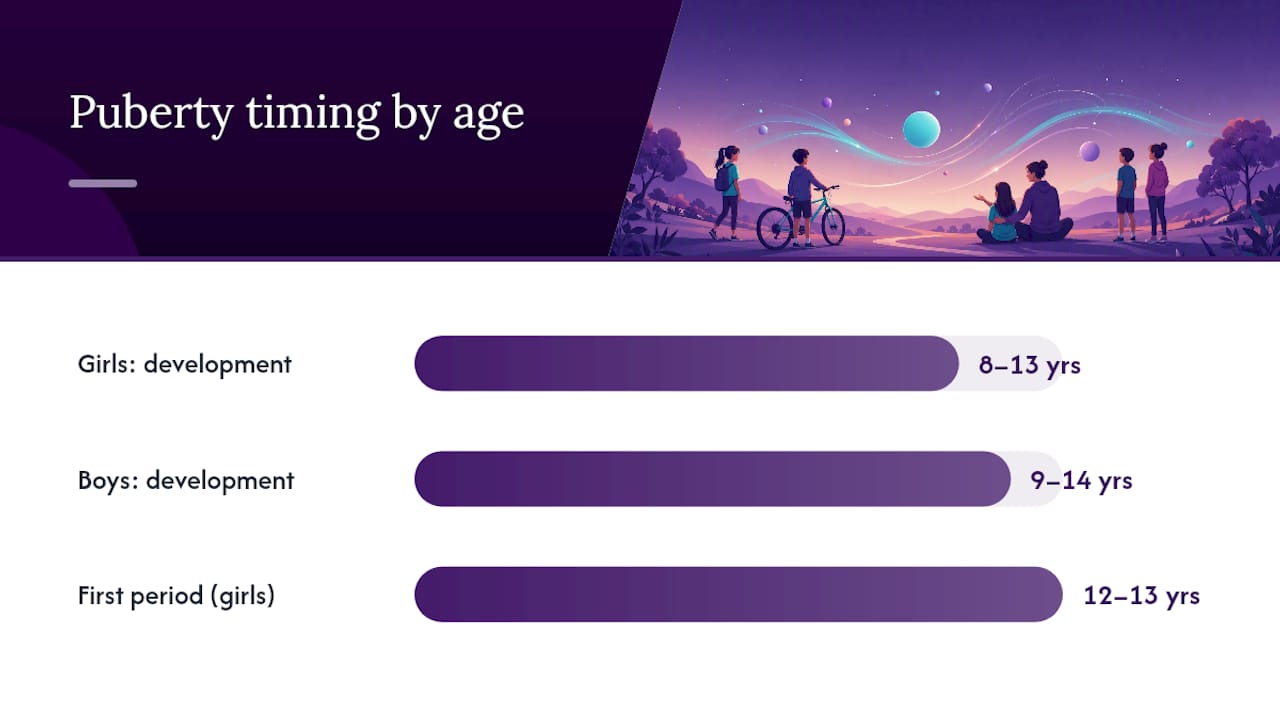
- Puberty signs can start as early as age 8 in girls and 9 in boys, with most girls getting their first period around age 12 to 13.
- Begin puberty conversations early with ongoing, low-pressure talks that include anatomical terms, observations, and questions over several years.
- Signs before age 8 or no signs by mid-teens should prompt a pediatrician visit, but most variations are normal with only rare need for specialist evaluation.
- Resistance from children is common; leaving books or kits for private exploration encourages questions without forcing discussions.
- Consistent, honest, and age-appropriate messaging over time beats trying to pick the “perfect” starting age or delivering one big talk.
Table of Contents
- What Age Does Puberty Start, and What Should You Watch For?
- How Do You Actually Start the Puberty Conversation?
- What Should You Cover, and When?
- What If Your Child Shuts the Conversation Down?
- When Should You Call the Pediatrician?
- Why Themonthliesbox Starts These Talks Early
- What Actually Matters More Than Picking the “Right” Age
- Optional Support for the Conversation: Puberty-Prep Kits
- Sources
What Age Does Puberty Start, and What Should You Watch For?
Puberty doesn’t wait for a permission slip, which is why timing the conversation matters more than getting it perfect. According to Nemours KidsHealth, some girls begin developing as early as age 8, with the typical range running through 13. Boys usually start a bit later, between 9 and 14. Most girls get their first period around age 12 or 13, generally a couple of years after the first visible signs appear.
That gap is the whole point. If you wait for obvious changes before saying anything, you’ve already missed the window where a heads up would have actually helped.
Here’s what tends to show up first, in roughly the order it appears:
- Breast budding (small, sometimes tender lumps under the nipple) in girls
- Testicular enlargement in boys, often the earliest sign, though it’s easy to miss
- Pubic and underarm hair growth in both sexes
- A noticeable growth spurt, sometimes several inches in a single year
- Body odor changes and increased oil production in skin and hair
Every timeline is different. A child who starts at 8 and one who starts at 12 can both be perfectly healthy. Genetics, body composition, and even family history all play a role, so resist the urge to compare your kid’s timeline to a sibling’s or a classmate’s.
If you notice signs before age 8, or nothing at all by the mid teens, that’s worth a call to your pediatrician. More on that later.
How Do You Actually Start the Puberty Conversation?
The biggest mistake parents make isn’t picking the wrong age. It’s treating the talk like a single event instead of an ongoing dialogue. Pediatric guidance from UNC Health consistently points the same direction: layer the information over time in short, low-pressure conversations rather than one big sit-down.
Here’s a sequence that works for most families:
- Use real anatomical terms early, well before puberty starts. Kids who grow up hearing “vulva” and “penis” instead of nicknames handle puberty talks with far less awkwardness later.
- Open with an observation, not a lecture. Try something like, “I noticed some kids at school are starting to talk about body changes. Have you noticed anything like that?” It invites a response instead of demanding one.
- Keep the first talk short. A few honest sentences beat a rehearsed speech. You can always circle back next week.
- Ask an open-ended question to close the loop: “What have you heard about this from friends or at school?” This tells you what they already know, and what’s flat wrong.
- Hand them something to read or watch if the conversation stalls. A good book removes the pressure of eye contact and lets them process at their own pace.
Pro Tip: Keep a book or age-appropriate kit somewhere neutral, like a nightstand or bookshelf, instead of handing it over directly. Kids often explore it privately first, then bring you questions on their own terms days later.
What Should You Cover, and When?
Puberty education isn’t one conversation. It’s a string of small ones that start years before anyone would call it “the talk.”
- Preschool: Teach correct names for body parts, and start basic privacy and consent concepts (“Your body is yours, and you get to say who touches it.”)
- Late elementary, ages 7 to 10: Introduce the basics of puberty and menstruation before physical signs appear, plus hygiene routines like deodorant and skin care.
- Middle school: Add hormones, emotional shifts, consent in relationships, and age-appropriate basics of sexual health and personal safety.
A simple prompt for each stage keeps things moving: “Your body is going to start changing over the next few years. Some of your friends might notice things happening to them first, and that’s totally normal.” That single sentence, repeated and expanded over a few years, does more than any one perfectly worded lecture ever could.
What If Your Child Shuts the Conversation Down?
Resistance is common, and it’s not a sign you’ve failed. One poll found roughly a quarter of parents of 10 to 12 year olds describe their child as reluctant to engage on the topic at all.
A few things that actually help:
- Leave a well chosen book, comic, or puberty kit somewhere your child will find it on their own, then follow up later with a casual “Did you look at that? What did you think?”
- Comics designed for this age group, like the science-focused titles from Brainie Comics, give kids a low-stakes way to absorb information without a parent hovering.
- Never force a conversation in the moment. Kids process on their own timeline, and pushing usually backfires.
- Ask your pediatrician to give your child a few private minutes during the annual checkup. Kids often ask questions to a doctor that they’d never bring up at the kitchen table.
When Should You Call the Pediatrician?
Most timing differences are normal. A short list of signs is not:
- Any puberty signs appearing before age 8
- No signs at all by the mid teens
- Unusually rapid changes over just a few months
- Noticeable asymmetry or severe pain
The Mayo Clinic advises evaluation for puberty that starts extremely early or is markedly delayed. Your pediatrician will typically track growth history, check pubertal staging, and refer to a pediatric endocrinologist only if something looks genuinely off. In most cases, the visit ends with reassurance, not a diagnosis.
Why Themonthliesbox Starts These Talks Early
I’ve watched enough families navigate this to notice a pattern: kids who hear about puberty early, in small doses, rarely panic when it actually starts. Kids who hear nothing often fill the gap with rumors from friends or social media, and that’s the version you’re trying to avoid.
That’s the thinking behind a method that focuses on affirming who your child already is, understanding what’s coming next, and equipping them with real tools before they need them. If you want scripts and age-specific guidance, a related blog post on when to start period talks between ages 7 and 10 walks through it in more detail.
What Actually Matters More Than Picking the “Right” Age
Most advice on this topic obsesses over the perfect starting age, as if missing some window by six months ruins everything. It doesn’t. What the research actually supports is a different priority: consistency beats timing.
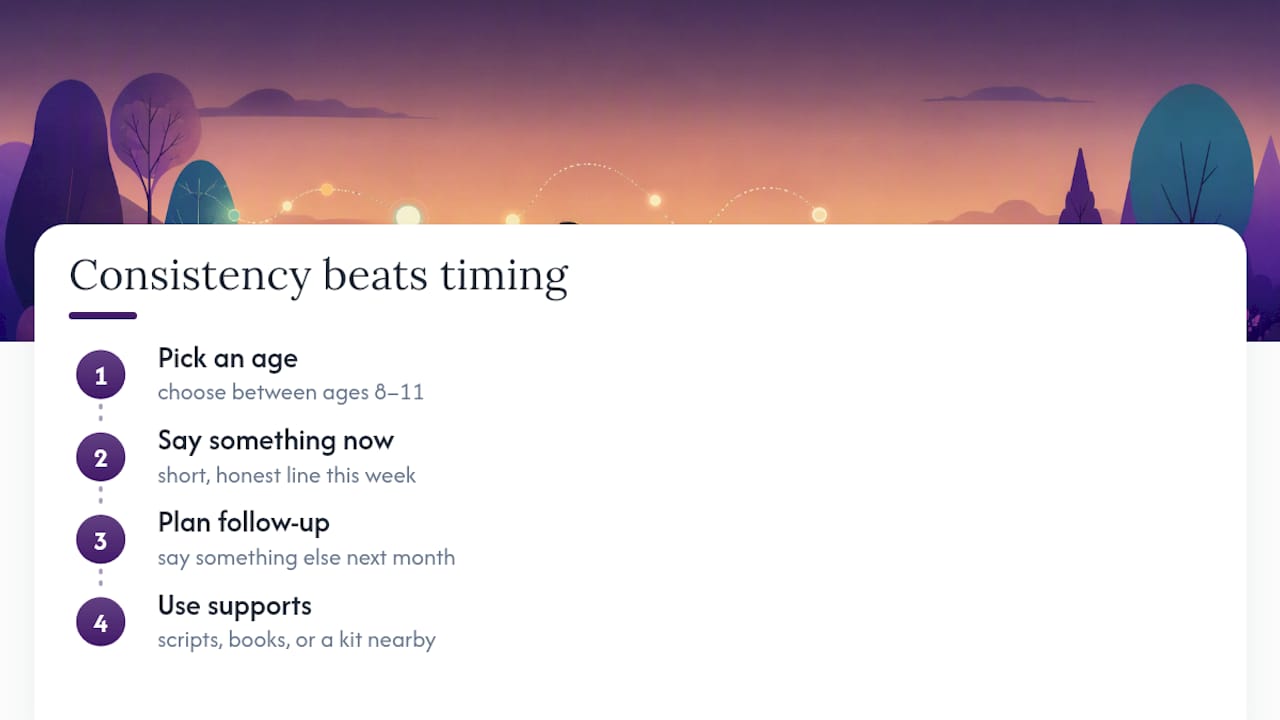
A parent who starts at age 9 with short, repeated, honest conversations will outperform a parent who waits for the “right moment” at age 11 and delivers one polished speech. The conventional advice undersells how much resistance is just normal kid behavior, not a sign you’ve handled things wrong. Don’t take a shut door personally.
If you take one thing from this article, make it this: pick an age in the 8 to 11 range, say something small this week, and plan to say something else next month. Scripts help. Books help. A well timed kit left on a nightstand helps. None of it replaces just starting, imperfectly, sooner than feels comfortable.
— The
Optional Support for the Conversation: Puberty-Prep Kits
A puberty-prep service exists for the moment right after you’ve started the conversation, when your child wants to keep learning but doesn’t want another sit down talk with you watching.
Our LavenHaven Care Package pairs educational materials and affirmation cards with practical supplies sized for tween bodies, giving your child something private to explore at their own pace instead of another parent-led lecture. For families who want something compact, the On-The-Go Kit fits in a backpack and covers the basics for a first period away from home, school, sleepovers, sports practice. Both are built around the same idea as everything above: information lands better in small, low-pressure doses than in one big reveal. If your child is approaching the age range we’ve talked about here, take a look at the LavenHaven Care Package and see which pieces fit where your family already is.
Sources
- The puberty talk: Parents split on best age to talk about body changes with kids
- Talking to Your Child About Puberty | Nemours KidsHealth
- Talking with children about puberty | Mayo Clinic local excerpt
This article is general information, not a substitute for advice from a qualified doctor. Consult a qualified healthcare professional about your own circumstances before acting on anything here.
0 comments